

Concepts and Tools
Measuring Impact & Transformation
Going IB/IGB means a change in the business line. Impact is what drives the return, and the return is what keeps the impact going.
IB/IGB creates transformative change for poverty reduction and economic growth. The shift is from mainstream commercial business, green business that counts only the environmental result, philanthropy, traditional or strategic CSR, and social enterprise that puts impact first. The destination is a business line in which impact drives return, and return drives impact.
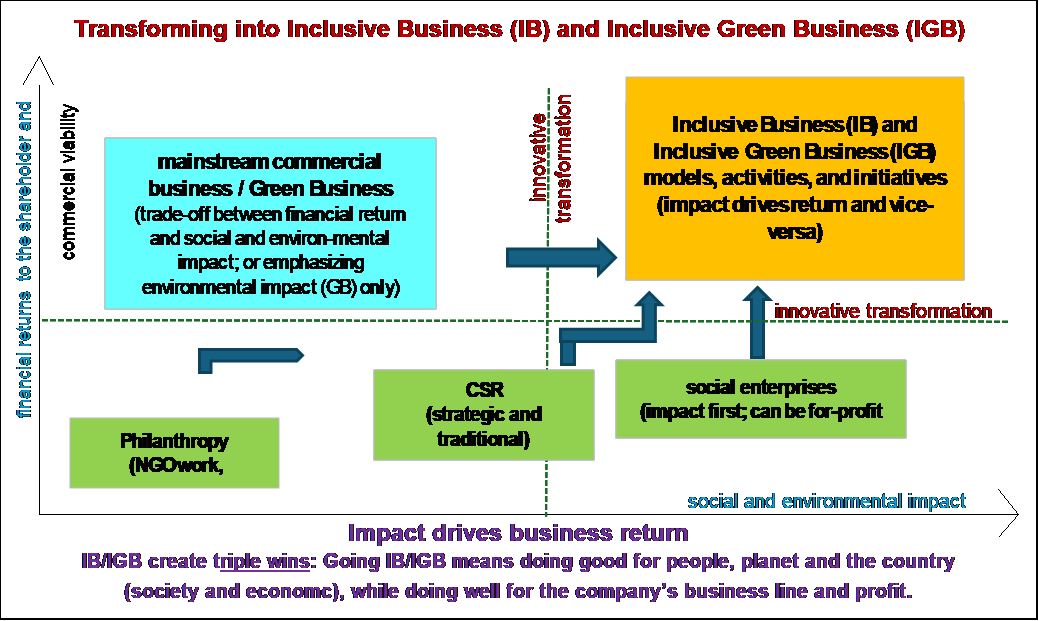
The bottom of that chart states the standard in one line: IB/IGB creates a triple win. Going IB/IGB means doing good for people, planet and the country, while doing well for the company’s business line and profit.
What is counted
To qualify, an initiative avoids self-claiming and impact washing. It uses result-based criteria for reach and BoP targeting, for income increase, and for innovation. Results that count are a rise in BoP income or an improvement in living standards, together with growth in business revenue and profit margins, an innovative design, and the ability to reduce business risk.
The accreditation tool turns those results into a rating. The accreditation page sets out the weights, the minimum scores, and the rule that accreditation lasts three years and can be renewed only if the targeted social, environmental and commercial results are achieved.
Four transformations
- Mainstream business becomes IB/IGB when the line is deliberately designed for BoP impact, not only for a trade-off between financial return and a social result.
- Green business becomes Inclusive Green Business when the environmental practice is also a social solution for the BoP.
- A social enterprise becomes an IB/IGB initiative when it combines impact with commercial scale.
- CSR becomes an IB/IGB activity when it is piloted as the core business line rather than kept beside it.