
Concepts and Tools
What is the BoP in Ghana
The base of the pyramid is the bottom 40 percent: the very poor, the poor, and the low-income.
The BoP, the main beneficiary of an IB/IGB firm, are the people at the base of the socio-economic pyramid. In this program they are the poor and low-income people, the bottom 40 percent of income groups. They are often not the only people a company reaches. They are the people the business line is designed for.
Assessments use agreed income thresholds. The BoP columns are the very poor (a $1.5 line), the poor ($2.15) and the low-income ($3.2). From the vulnerable ($6.85) upward, people are treated as better off. Rural and urban households are assessed on different cedi thresholds.
| Threshold | Very poor ($1.5 a day) | Poor ($2.15) | Low-income ($3.2) | Vulnerable ($6.85) | Economically secure ($15) | Middle-class and rich |
|---|---|---|---|---|---|---|
| Monthly household income (GHS) | ||||||
| Overall | < 1,500 | 1,500–2,500 | 2,500–4,000 | 3,000–7,000 | 7,000–15,000 | > 15,000 |
| Rural areas | < 1,000 | 1,000–2,000 | 2,000–3,000 | 3,000–6,000 | 6,000–12,000 | > 10,000 |
| Urban areas | < 1,500 | 1,500–3,000 | 3,000–5,000 | 5,000–10,000 | 10,000–20,000 | > 20,000 |
| Monthly household income (USD) | ||||||
| Overall | 120 | 250 | 350 | < 650 | < 1,500 | > 1,500 |
| Rural areas | 90 | 300 | 300 | < 600 | < 1,200 | > 1,200 |
| Urban areas | 150 | 300 | 450 | < 700 | < 1,500 | > 1,500 |
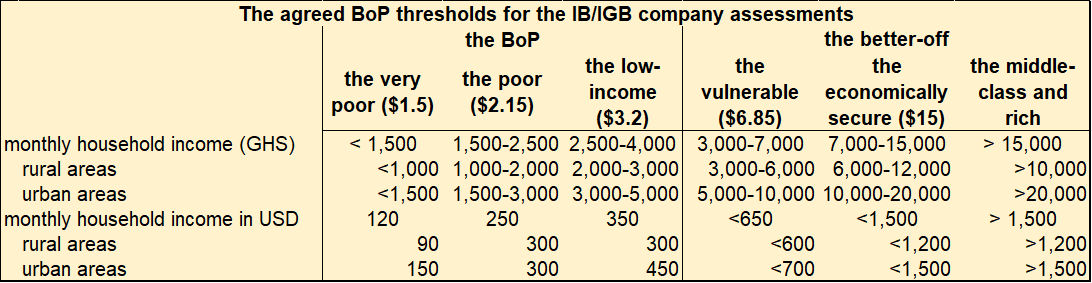
These thresholds are the reference for reach and for BoP targeting when a business line is assessed. Income models are judged on whether the people in these groups earn more than the market rate, more than they earned three to five years earlier, and more than people engaged by other companies.