

Concepts and Tools
What are IB & IGB Business lines
The business line is what qualifies a company. A company may have several lines, and only the line that is designed for BoP impact is assessed as IB/IGB.
Inclusive Businesses and Inclusive Green Businesses are commercially viable business lines of private sector companies that are deliberately designed to create scaled-up, innovative, and systemic solutions for the relevant income and living standards (IB) or environmental (IGB) challenges of the poor and low-income people in Ghana.
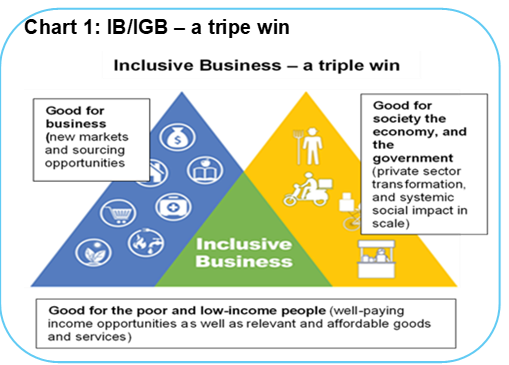
IB/IGB business lines can be in all sectors. They can be sponsored by companies of any size except micro, measured in revenue. The triple win is the reason to transform: higher income, better living standards and less environmental risk for the poor; new markets, new value chains, lower business risk, revenue growth and profit for the company; and growth, poverty reduction, inclusion and environmental sustainability for society and the economy.
What most IB/IGB models look like
Most IB/IGB models are sponsored by medium-sized businesses, often in the agribusiness sector. They work through direct value chains and avoid indirect impact claims. Some have specific environmental features, and some have women-empowerment features — empowerment, not simply women engaged as participants or women as business owners. Creating employment is not the focus. The focus is income opportunities or better living standards, so that people can leave poverty over time. These business lines avoid trickle-down assumptions, indirect impact reporting, and impact washing.
The tests
Commercial viability is the precondition for any of these business lines to last. Beyond that, the criteria depend on the route to impact.
- IB income models create income higher than the market rate (20 percent), higher than before (40 percent more than three to five years ago), and higher than other companies (10 percent), so that poor, very poor and low-income people can leave poverty and move up.
- IB living-standards models offer products or services that are affordable for the BoP, accessible to them, and particularly relevant for them, and that create systemic change for the BoP.
- IGB models are designed to address pollution and circular production; ensure sustainable natural resource management, including energy; reduce the company’s climate footprint; scale the relevance and the systemic environmental contribution; make money with environmentally sound practice; and create social solutions for the BoP through the environmental and climate features of the business.
How IB/IGB differs from neighbouring ideas
IB/IGB is distinguished from mainstream business by the deliberate design for BoP impact. It differs from social enterprise initiatives and from corporate social responsibility by its scale, its systemic change, and its commercial viability. Inclusive Green Business is distinguished from green business by the deliberate design for BoP impact and for results for society.
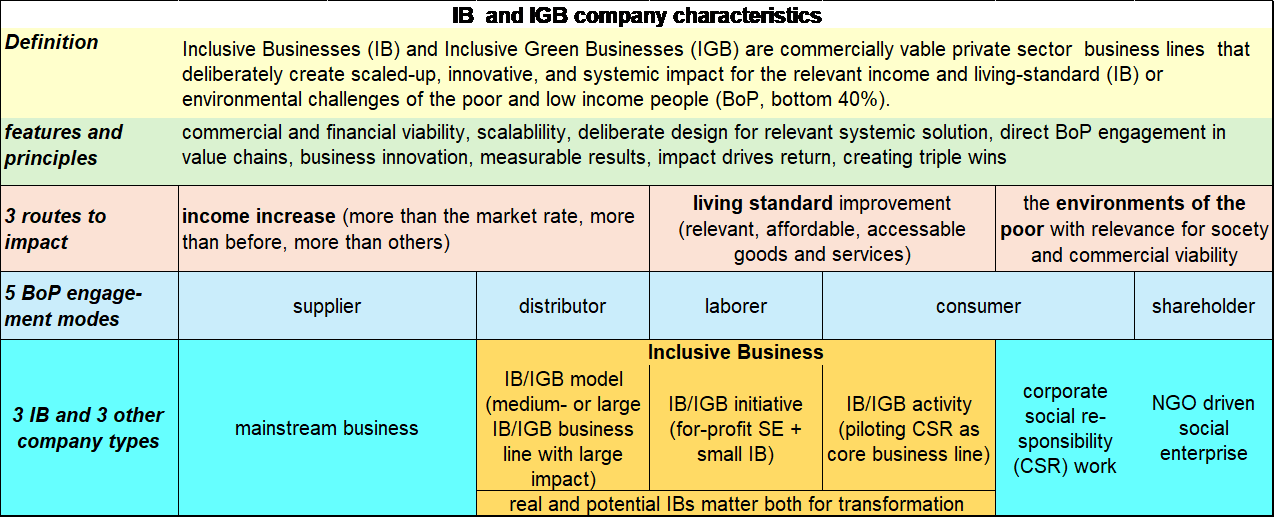
| Definition | Commercially viable private-sector business lines that deliberately create scaled-up, innovative and systemic impact for the income and living-standard challenges, or the environmental challenges, of poor and low-income people (the BoP, the bottom 40 percent). |
|---|---|
| Features and principles | Commercial and financial viability, scalability, deliberate design for a relevant systemic solution, direct BoP engagement in value chains, business innovation, measurable results, impact that drives return, and a triple win. |
| Three routes to impact | Income increase, above the market rate, above the earlier level, and above other companies. Living-standard improvement through relevant, affordable and accessible goods and services. The environment of the poor, with relevance for society and with commercial viability. |
| Five ways the BoP takes part | Supplier, distributor, laborer, consumer, or shareholder. |
| Three IB/IGB company types | An IB/IGB model: a medium or large business line with large impact. An IB/IGB initiative: a for-profit social enterprise and a small IB. An IB/IGB activity: CSR piloted as the core business line. Real and potential IB/IGB both matter for the transformation. Mainstream business, CSR work, and NGO-driven social enterprise sit outside these three types. |