Support Programs
Accreditation
A committee of four private-sector and four public-sector agencies decides, once a year, which business lines qualify.
Accredited IB/IGB companies are awarded under the AGI business award. They have access to investment and Impact-Drives-Return incentives, and they are prioritised in financing support.
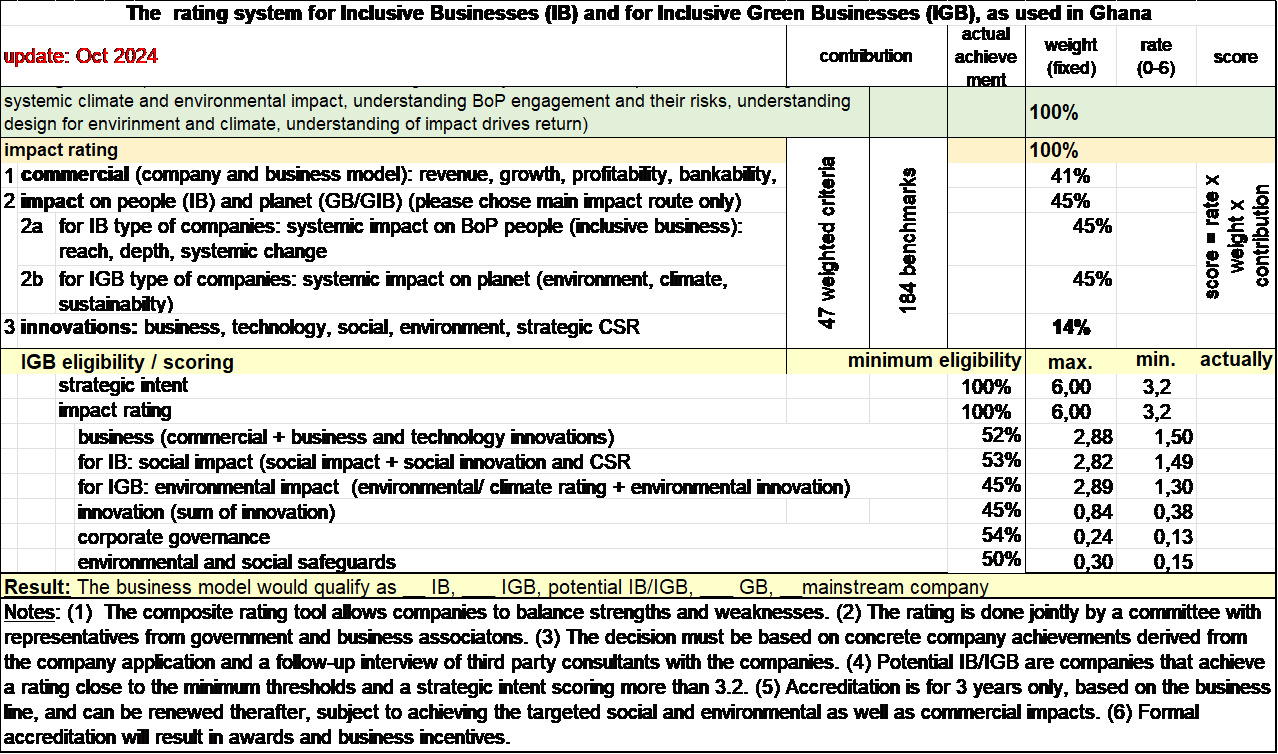
Companies are accredited by evaluating interview results through a transparent composite rating tool. The program describes that tool as 48 indicators and 187 benchmarks. The rating sheet issued for Ghana, updated in October 2024, sets the calculation out as 47 weighted criteria and 184 benchmarks. Both descriptions are kept here. The sheet is the working tool. The narrative figure is the one used in the program summary.
With third-party consultants doing the background work, rounds were held in 2024 and 2025. They accredited 27 business lines. In 2025 those lines had a cumulative revenue of GHS 1.182 billion and reached 2.3 million poor and low-income people. Revenue is projected to double by 2030, and BoP reach is projected to rise by 70 percent. A third round is planned for October 2026.
How a business line is scored
The composite tool lets a company balance strengths and weaknesses. The rating is done jointly by a committee of government and business-association representatives. The decision has to rest on concrete achievements, taken from the company application and from a follow-up interview by third-party consultants. The result of an assessment is one of: IB, IGB, potential IB/IGB, green business, or mainstream company.
| Component | Weight |
|---|---|
| Strategic intent: IB/IGB commitment, route to systemic social impact, route to systemic climate and environmental impact, BoP engagement and risk, design for environment and climate, and impact drives return | 100% |
| Impact rating | 100% |
| 1. Commercial (company and business model): revenue, growth, profitability, bankability | 41% |
| 2. Impact on people (IB) and planet (GB/IGB). One main impact route is chosen. | 45% |
| 2a. For IB: systemic impact on BoP people — reach, depth, systemic change | 45% |
| 2b. For IGB: systemic impact on the planet — environment, climate, sustainability | 45% |
| 3. Innovations: business, technology, social, environment, strategic CSR | 14% |
| Area | Share | Maximum | Minimum |
|---|---|---|---|
| Strategic intent | 100% | 6.00 | 3.2 |
| Impact rating | 100% | 6.00 | 3.2 |
| Business (commercial, plus business and technology innovations) | 52% | 2.88 | 1.50 |
| For IB: social impact (social impact, social innovation and CSR) | 53% | 2.82 | 1.49 |
| For IGB: environmental impact (environmental and climate rating, plus environmental innovation) | 45% | 2.89 | 1.30 |
| Innovation (sum of innovation) | 45% | 0.84 | 0.38 |
| Corporate governance | 54% | 0.24 | 0.13 |
| Environmental and social safeguards | 50% | 0.30 | 0.15 |
- Potential IB/IGB companies are those that score close to the minimum thresholds and score more than 3.2 on strategic intent.
- Accreditation lasts three years. It is given for the business line, not as a permanent label for the whole company.
- It can be renewed only if the targeted social, environmental and commercial impacts are achieved.
- Formal accreditation leads to awards and to business incentives.
The companies already accredited are listed under IB/IGB companies to date.